Co-incubation of Short Amphiphilic Peptides with Dicer Substrate RNAs Results in β-Sheet Fibrils for Enhanced Gene Silencing in Cancer Cells

Original Research Article

Authors

  • Kshitij Gupta RNA Biology Laboratory, Center for Cancer Research, National Cancer Institute, National Institutes of Health, Frederick, MD, 21702, USA; Present address: Genes N Life Healthcare Pvt. Ltd., Hyderabad, Telangana,500082, India Author
  • Lorena Parlea RNA Biology Laboratory, Center for Cancer Research, National Cancer Institute, National Institutes of Health, Frederick, MD, 21702, USA Author
  • Mathias Viard RNA Biology Laboratory, Center for Cancer Research, National Cancer Institute, National Institutes of Health, Frederick, MD, 21702, USA; Basic Science Program, Leidos Biomedical, Research Inc., Center for Cancer Research, National Cancer Institute, National Institutes of Health, Frederick, MD, 21702, USA; Author
  • Katelyn Smith Pharmaceutical Sciences, Merck Research Laboratories, Merck & Co., Inc, Kenilworth New Jersey, USA; Author
  • Anu Puri RNA Biology Laboratory, Center for Cancer Research, National Cancer Institute, National Institutes of Health, Frederick, MD, 21702, USA; Author
  • Joseph T. Bergman RNA Biology Laboratory, Center for Cancer Research, National Cancer Institute, National Institutes of Health, Frederick, MD, 21702, USA; Author
  • Taejin Kim RNA Biology Laboratory, Center for Cancer Research, National Cancer Institute, National Institutes of Health, Frederick, MD, 21702, USA; Department of Physical Sciences, West Virginia University Institute of Technology, Beckley 25801, West Virginia, USA Author
  • Bruce A. Shapiro RNA Biology Laboratory, Center for Cancer Research, National Cancer Institute, National Institutes of Health, Frederick, MD, 21702, USA; Author

DOI:

https://doi.org/10.59566/isrnn.2024.0101061

Keywords:

amphiphilic peptides, β-sheet fibrils, RNA interference, Dicer substrate RNA, RNA-peptide co-evolution, peptide folding energy landscape, cancer

Abstract

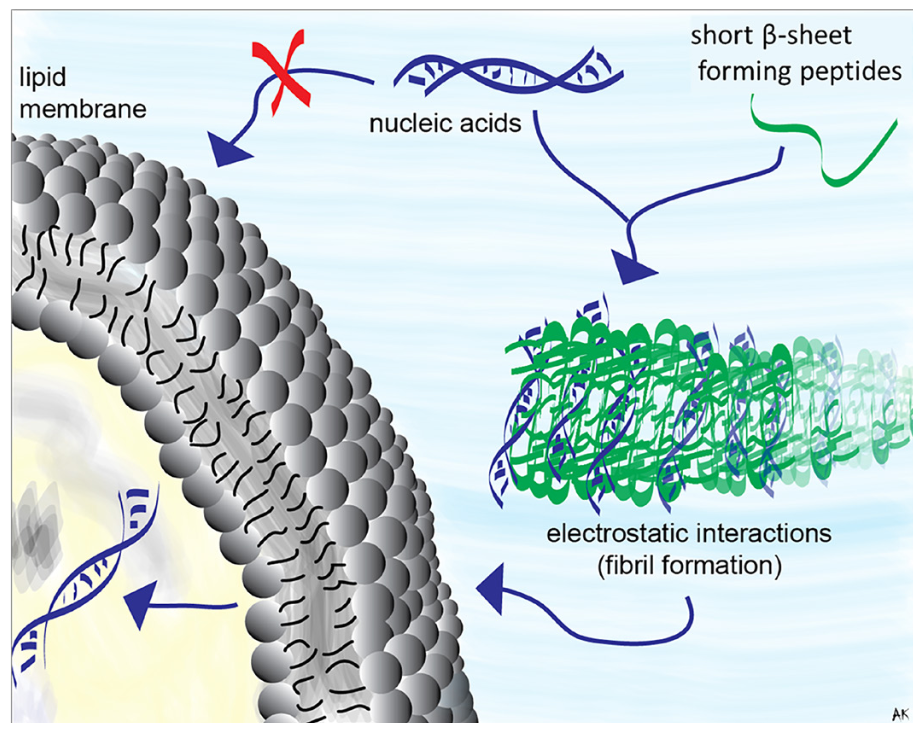
RNA can interact with positively charged, amphiphilic peptides to cooperatively assemble into fibrils that enable RNA transport across cancer cellular membranes. RNA decreases the folding energy barrier imposed by the electrostatic repulsion between these charged peptides, thus partaking in RNA-peptide self-assembly along particular pathways in the energy landscape. Specific amphiphilic peptides capable of protecting and transporting RNA across a membrane have Type II’ β-turn hairpin forming motifs in their structures, which aids self-assembly into β-sheet fibrils. We employed a set of such cationic, amphiphilic peptides that have random coiled structures in the absence of folding stimuli, to characterize the (peptides):(RNA) assembly. We subjected these complexes to extensive biophysical characterization in vitro and in cell culture. We show that short RNAs (such as Dicer substrate RNAs) can lead these peptides to self-assemble into β-sheet fibrils that have RNA transport capabilities and can act as non-viral delivery vectors for RNA. Modulation in the peptide sequence implicitly alters the way they bind RNA and influence the peptides’ ability to transport nucleic acids across membranes.

Downloads

Published

2024-12-13